
Stephanie Philips on Why Community Service Projects Are The Heart of Rotary's Mission
“Our Rotary projects not only change lives locally but create ripple effects that extend globally, bridging communities in meaningful ways.” – Stephanie Philips, Rotary District 7980
From the bustling towns of Southern Connecticut to relief hubs across the globe, community service projects stand as the beating heart of Rotary’s mission. According to Stephanie Philips, the 2025–2026 District Governor for Rotary District 7980, engaging in hands-on service isn’t just about giving back—it’s an act that connects individuals with a global purpose. Rotary, she explains, has long transformed local empathy into action, building a bridge between our neighborhoods and the world at large. Today’s challenges—whether supporting disaster relief, promoting literacy, or improving health—require clubs to deliver projects that resonate deeply within their communities while extending a helping hand to those facing crises far away.
For Rotary Club Presidents, Community Service Chairs, District Governors, and leaders in the nonprofit and corporate sector, this mission goes beyond charity; it’s about generating sustainable prosperity through collaboration. As Stephanie Philips asserts, the effectiveness of Rotary’s work is rooted in its ability to design and execute community service projects that are not only meaningful but also aligned with Rotary’s far-reaching humanitarian values. These initiatives reflect the aspirations of local residents and the shared resolve of Rotarians to ensure that every effort echoes on a global scale.
Membership and Meaning: How Community Engagement Inspires Sustained Rotary Involvement
“Understanding that our community activities have a global impact helps attract and retain committed members who want to make a difference.” – Stephanie Philips, Rotary District 7980
According to Stephanie Philips, one of the most powerful rewards of community service projects is how they inspire deeper member commitment and draw new people into Rotary’s fold. By highlighting that each act of service can ripple outward, reaching communities hundreds or thousands of miles away, Rotary creates a sense of pride and purpose among its members. Stephanie observes that newcomers often join Rotary because they see tangible, local improvements—whether food drives alleviating hunger or scholarships enabling youth success—but stay involved because they recognize the significant influence their actions have worldwide.
This connection between local engagement and global impact is, as Philips puts it, “the glue that builds loyalty and leadership within clubs.” Members are energized not only by hands-on service but by the knowledge that their work is part of Rotary’s international drive for peace, health, and prosperity. By cultivating opportunities where people see their effort amplifying across borders, Rotary Southern Connecticut clubs both attract fresh talent and empower longstanding members to stretch their ambitions, all while fortifying the district’s enduring legacy of humanitarian achievement.
Blueprint for Success: Designing Community Service Projects That Are Impactful and Sustainable
Strategic Review and Long-Term Planning Underpinning Every Project
“Each project we undertake is carefully vetted to ensure it meets real community needs and generates sustainable benefits.” – Stephanie Philips, Rotary District 7980
Crafting impactful community service projects demands both vision and rigor. Stephanie Philips emphasizes that Rotary District 7980 employs a thorough review process to guarantee every project achieves lasting outcomes. “We start by listening—we consult local leaders, stakeholders, and those directly affected to identify genuine needs,” she notes. This consultative approach ensures that every initiative is rooted in relevance and authenticity, not just good intentions.
The district’s strategy is founded on long-term planning and measurable goals. “Our projects are never one-and-done,” says Philips. “We demand sustainability—initiatives must be able to grow or adapt even after initial launch.” This philosophy requires not just setting objectives, but building in processes for outcome measurement and adaptation. By aligning every local project with Rotary International’s broader mission—such as fighting disease or promoting peace—the district ensures that every hour and dollar invested delivers both community-specific relief and a contribution to the Rotary world’s shared aspirations.
For those seeking practical guidance on project planning, the Rotary Resources page offers a wealth of tactical tools and templates to help clubs structure, implement, and evaluate their community service initiatives effectively.
- Step 1: Identify local community needs in consultation with stakeholders
- Step 2: Align projects with Rotary International’s global mission
- Step 3: Implement projects with measurable goals and sustainability plans
- Step 4: Monitor impact and adapt for continuous improvement

Powerful Local & Global Impact: Real-World Examples from District 7980
- Disaster relief funding and supplies sent to North Carolina and Hawaii flood victims
- Scholarship sponsorships empowering youth in Southern Connecticut and beyond
- Food donation drives alleviating food insecurity for underserved populations
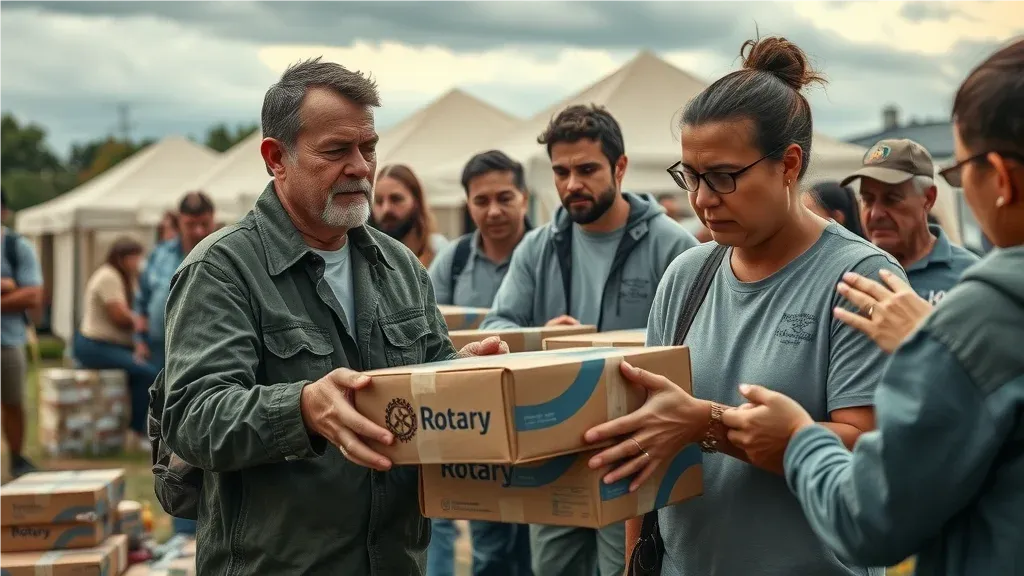
Stephanie Philips illustrates this local-global synergy through real stories. During recent disasters in North Carolina and Hawaii, Rotary galvanized both volunteers and resources to provide critical funding, food, and supplies directly where they were needed most. Such efforts not only deliver help in the moment but send a strong message: “Our community service projects aren’t just about immediate relief; they’re about standing in solidarity with those facing hardship everywhere,” says Philips.
Equally impactful are ongoing scholarship initiatives and food drives. According to Stephanie, “These long-term projects empower our youth and combat the chronic issue of food insecurity. Their design means the benefits multiply for years to come.” In each project, District 7980’s clubs serve as models of what’s possible when communities come together with clarity of purpose and a commitment to making both a local and a worldwide difference.
How Local Efforts Amplify Global Humanitarian Reach
According to Stephanie Philips, “The genius of Rotary’s model is how club projects in Southern Connecticut can spark change both at home and abroad.” When a local club responds to a crisis—such as flooding or disaster recovery—it can quickly tap into the broader Rotary network. This results in not only more robust service delivery but in the cultivation of enduring community relationships. Philips explains that what begins with a food drive or scholarship campaign in Connecticut regularly blossoms into broader humanitarian action, connecting clubs and amplifying outcomes across borders.
The expert emphasizes the importance of every member seeing themselves as both a local and global citizen. This mindset infuses even seemingly routine projects in Connecticut with a sense of shared destiny. “By continually sharing best practices and collaborating across districts, we turn local ideas into global action—and ensure our projects inspire, engage, and change lives around the world,” Philips says. Rotary District 7980 thus exemplifies how regional coordination lays the groundwork for international transformation.
Leveraging District 7980 Support To Maximize Your Club’s Community Service Impact
- Access to training and leadership development resources
- Best practices sharing among clubs to refine project effectiveness
- Collaborative fundraising event planning to boost community engagement
For Rotary leaders and club officers, leveraging the resources of District 7980 is pivotal to expanding the reach and performance of community service projects. As Stephanie Philips points out, the district acts as a hub—offering robust leadership training, project management resources, and opportunities for peer learning. This collaborative infrastructure doesn’t just support individual clubs; it raises the bar for what service can achieve throughout Southern Connecticut.
One of the most powerful assets, Philips notes, is shared knowledge. Clubs that participate in district-wide training or idea exchanges often find themselves equipped with creative solutions and program enhancements they might never have conceived alone. Paired with coordinated fundraising efforts—like citywide charity walks or innovative community events—this networked approach multiplies the visibility and effectiveness of every project delivered under Rotary’s guiding banner.

Key Takeaways for Rotary Club Leaders and Community Service Chairs
- Community service projects must be carefully planned and reviewed for meaningful impact
- Sustainability ensures lasting benefits beyond short term efforts
- Connecting local projects to global Rotary missions strengthens membership and engagement
According to Stephanie Philips, club success isn’t measured solely by what is accomplished in the moment, but by what endures and inspires. Each community service project must be built for impact—reviewed for effectiveness at every stage—and always mapped to sustainability goals that promise lasting good. The alignment of local projects with Rotary International’s priorities does more than increase visibility; it fosters leadership at every level, creating clubs that thrive on engagement, innovation, and the drive to serve.
Philips encourages today’s leaders to “think holistically and plan for tomorrow, even as we deliver change today.” The integration of these principles ensures that clubs are not only agents of transformation in their towns but also contributors to a worldwide legacy—a network of compassion, action, and hope that starts with the individual and expands to the entire globe.
FAQs: Optimizing Community Service Projects Within District 7980
- How can clubs best identify impactful project opportunities?
Clubs should start with conversations—soliciting input from local residents, partner organizations, and stakeholders. According to Stephanie Philips, it’s vital to listen first, ensuring every project addresses real, unmet needs. - What resources does District 7980 provide to support project sustainability?
The district offers training sessions, grant opportunities, best-practice exchanges, and project management tools, all designed to help clubs ensure long-term impact and measurable outcomes. - How do local projects align with Rotary International’s global priorities?
By mapping every initiative to at least one of Rotary’s global focus areas—peace, disease prevention, water, education, or economic development—clubs ensure synergy between their local work and Rotary’s worldwide mission, maximizing both relevance and reach.
Conclusion: Empowering Your Rotary Club to Create Lasting Community Change
“By uniting our efforts, we transform local needs into global solutions—ensuring Rotary’s mission thrives in Southern Connecticut and beyond.” – Stephanie Philips, Rotary District 7980
The path to transformative, sustainable community service projects starts with listening, planning, and reaching beyond boundaries. As Stephanie Philips has shown, Rotary District 7980’s approach—grounded in local relevance and global ambition—offers a model any club leader or service chair can follow to spark genuine impact. By drawing on district-wide resources, sharing knowledge, and aligning with the broader Rotary mission, leaders can ensure their clubs remain beacons of hope, energy, and innovation for generations to come.
To move from insight to action, consider getting involved with your local Rotary club, exploring leadership opportunities, and uniting your passion with Rotary’s proven framework for sustainable service. Together, we build communities that thrive, inspire, and shape a better world.

Next Steps: Join Rotary to Lead Sustainable Community Service Projects
Ready to make your mark? Join Rotary District 7980 in Southern Connecticut and become part of a dynamic network of leaders passionate about community service projects that drive real change
To further enhance your understanding of impactful community service projects, consider exploring the following resources:
- “10 Creative Community Service Ideas”: This article offers innovative approaches to community service, such as organizing neighborhood clean-ups and supporting houseless neighbors through initiatives like “Walls of Love.” (ioby.org)
- “6 Community Service Projects You Can Plan with Groundswell”: This resource provides practical ideas for community service, including tree planting and food bank volunteer days, emphasizing collaboration with local organizations. (groundswell.io)
These resources offer valuable insights and actionable ideas to help you design and implement community service projects that resonate both locally and globally.